Does government debt harm future generations, as it is often argued? Government borrowing is argued to be immoral because of the supposed burden it places on our children, and our children's children, and so on. Higher debt-financed consumption today makes future generations poorer tomorrow, so the argument goes. An article in the Telegraph last year entitled, 'It's time to come clean about our national debt' used this very same argument. Liam Halligan, the article's author, said:
Why should we borrow so much, foisting our profligacy on our children and grandchildren...A spiralling national debt isn't only bad economics, but is also morally repugnant.
Unfortunately, the Economic View feels the need to point out, the economic logic behind the above argument does not completely hold. In theory, government debt need not necessarily leave future generations any worse of at all overall - net. This is because, for every pound the government borrows, there must be someone on the other side lending that money. So, assuming all government debt is held only domestically, the 'burden' on future generations will be zero. While some parts of the population will pay higher taxes to service the debt, another section will receive interest payments for lending the government that money in the first place (and these two groups are likely to overlap). Of course, there are many other reasons that excessive government debt may be undesirable in terms of its effects on future generations, not least the distributional consequences, but in terms of the question of a net burden on society, the case does not hold.
Having said that, around 1/3 of government debt is in foreign hands, and so there will be a net 'burden' on society in the future to an extent. The assumption that all government debt is held domestically is not completely accurate in Britain.
Although, even then the argument over whether government debt burdens future generations is not settled. It depends on how the government spends the money it borrows. If it is being used to finance short-term consumption, then, yes, the fact that around 1/3 of our debt is foreign owned will mean that we are enriching ourselves at the expense of future generations. But, if the money is used to finance vital, beneficial long-term investments in, say, infrastructure, then future tax payers will feel the benefits of that spending, as well as the costs, and so not necessarily be worse off overall.
So, while in theory government debt needn't leave a net burden on future generations, in reality it probably will to an extent. However, as shown, when government debt is domestically held (as 2/3 of British government debt is), hyperbolically stating that government borrowing is 'morally repugnant', irresponsible and so on, is clearly a huge exaggeration. As the economic logic shows, the majority of British government debt will, in fact, not leave future generations worse off.
Showing posts with label government. Show all posts
Showing posts with label government. Show all posts
Saturday, 21 February 2015
Sunday, 8 February 2015
Why Governments Bribe Old People - Public Choice Economics
George Osborne, Chancellor of the Exchequer, today announced that government-backed pensioner bonds, offering interest rates of up to 4%, will be offered for an extra 3 months. These 'granny bonds' have, unsurprisingly, proven extremely popular due to the high interest rate being offered, and 600,000 people have now signed up. This latest offering from the government comes on top of a host of other universal benefits already offered to the old, including the winter fuel allowance, free tv licenses and free bus passes. The current government also introduced the 'triple lock' system for pensions, meaning the state pension will increase by whichever is highest out of inflation, average earnings growth, or 2.5% per year. On top of this, the coalition government has protected spending on the National Health Service (NHS), 'ring fencing' the department on which the old particularly rely, while also announcing this week that the education budget is set to face real terms cuts next parliament. Evidently, pensioners are getting a mightily good deal, particularly in the context of the fiscal austerity of the current parliament. It's no coincidence that the old are getting such a good deal, and it can be explained largely through some good, old-fashioned economics.
The Public Choice school of economics provides valuable insights into the workings of a democracy. It analyses and explains the behaviour of politicians by studying incentives. It argues that, in the political realm as in the economic realm, incentives matter and people respond strongly to the incentives that they face. Politicians aim to maximise their share of the vote; they want to get elected and, after, stay in power. So why would enlarging the benefits offered to pensioners or, some might say, bribing them, achieve this end?
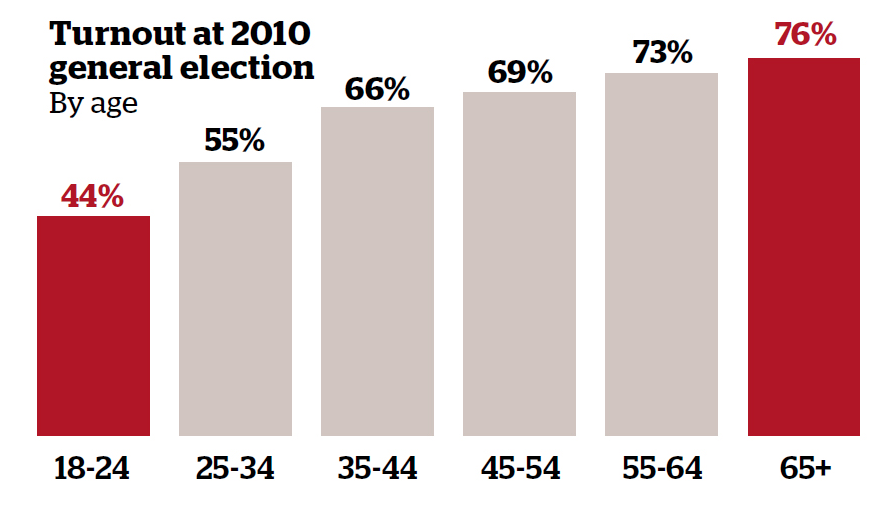
Firstly, pensioners are numerous. Current figures reveal there are 10 million people aged 65 or over living in the UK. The proportion of old people in the UK is growing too. In 1971, 20% of the population was aged 60 or above, but by 2020 this figure is projected to be one third. Old people are not just large in number, but are more likely to vote too. In 2010, 94% of those aged 65 and over had registered to vote, with 76% of these going to the ballet box on election day. Contrastingly, only 55% of people aged 18-24 were registered to vote, with only 44% of registered voters in this age group ultimately doing so. Evidently, the power of the 'grey vote' is enormous and it is not hard to see why UK governments pursue the policies they do towards old people.
Now, this analysis does not, of course, mean that electoral incentives are all that politicians care about, or that all pensioners only vote to maximise their own self-interest. What is does show however, is that, as in much of society and life, many phenomena can be explained by a simple study of incentives and the analytical framework of economics. The economists' toolkit comes in handy once again.
Subscribe to:
Posts (Atom)